The changing rhythm of work
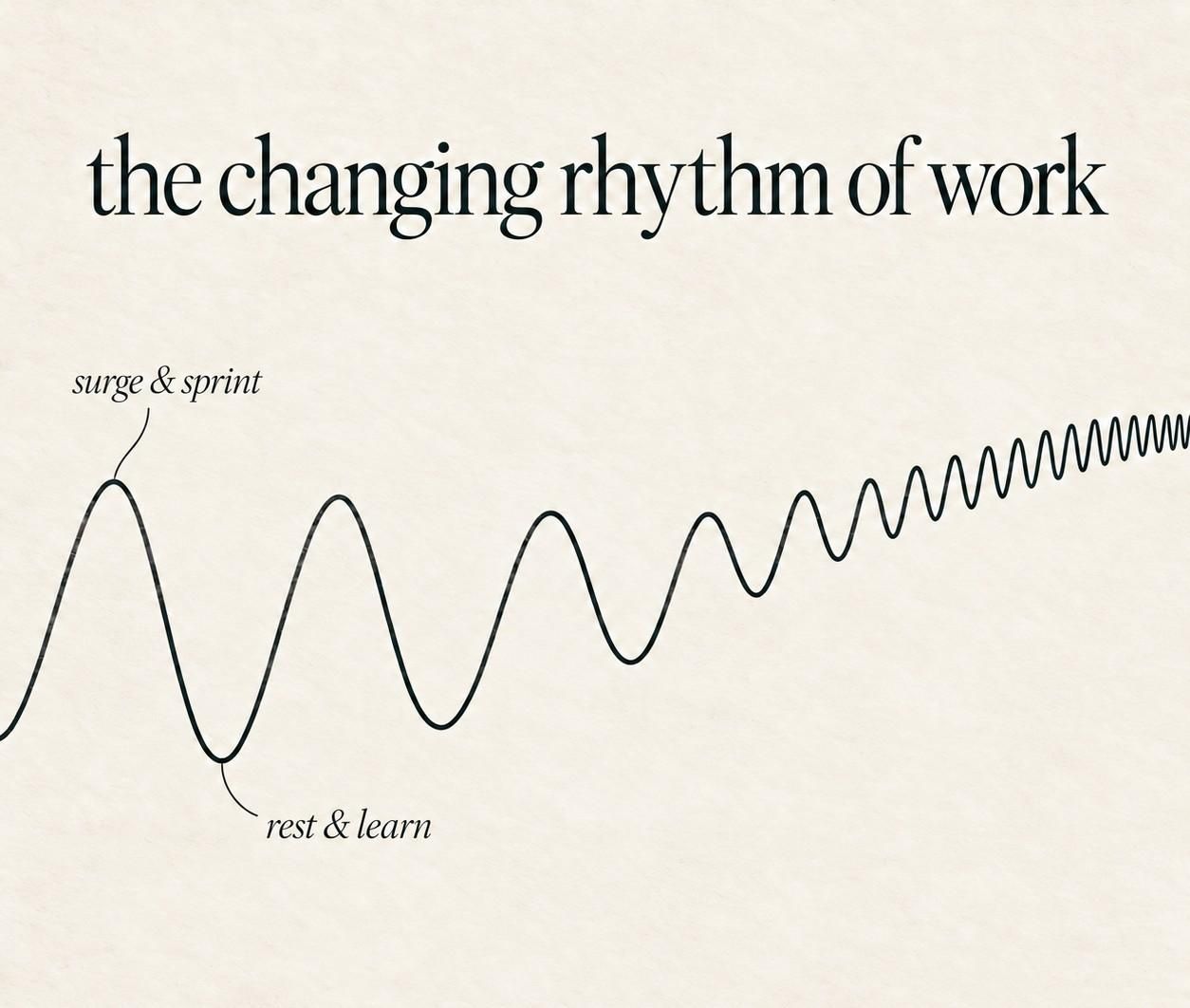
One of my earliest managers taught me to think of work as a sine wave: sprints and valleys. When I complained about my first slow period, her advice was basically: enjoy it. The next sprint will come.
These days that sine wave has collapsed into a continual sprint. There is barely time for the new normal to become normal before technology, expectations, workflows, or possibilities shift again.
This helps explain something I find fascinating about AI at work today: the same person can be thrilled by the intellectual challenge on Tuesday and anxious about their job on Thursday. From a product PoV, that matters for adoption. Even amid a broader transformation, a particular change can meet resistance. We tend to reduce that to: people don't like change, but they'll come around.
Maybe. But for an industry obsessed with accelerating AI adoption, we can be remarkably uncurious sometimes about what's underneath that resistance. Tech itself is an interesting lab for this right now: excitement, ambition, experimentation, skepticism, status anxiety, fear, resistance, and reinvention are all playing out among the people building it.
For example, let's look at a common problem: a team's AI adoption is slow. Why? Maybe AI isn't helping much with their core workflows. Why? Maybe those workflows aren't yet structured to be easily augmented or automated.
Keep pulling on that thread and the possibilities branch. Maybe the workflow is hard to change, the product breaks down in edge cases that aren't so edge after all, adoption creates new review work, or people aren't motivated to restructure a workflow when doing so feels suspiciously like helping automate themselves out of it.
Suddenly we're no longer talking about "resistance to change". We're talking about product quality, workflow design, incentives, trust, job identity, and who participates in the upside of increased productivity. Each implies a very different intervention.
This is why productivity stats can only get us so far. "30% faster" can be an excellent product result, but the measured task may be a tiny piece of the actual job. AI may create new review work. People may not trust it in high-stakes cases. The incentives may simply be broken.
The stat isn't wrong, it's just incomplete and doesn't lead to adoption on its own.
This matters because work is changing. We'll delegate increasingly meaningful work to AI, including work that can be done autonomously. As these systems become more capable and autonomous, the product problem isn't only "can the AI do the work?", it's also: what is the right scope to delegate? When will a person or organization trust it enough to hand that work over?
Maybe sometimes low adoption really is aversion to change. But if we dismiss all resistance that way, we may throw away exactly the signal that could help us build better products and make the transition work.
If the goal is durable AI adoption, interrogating the friction is part of the product work.